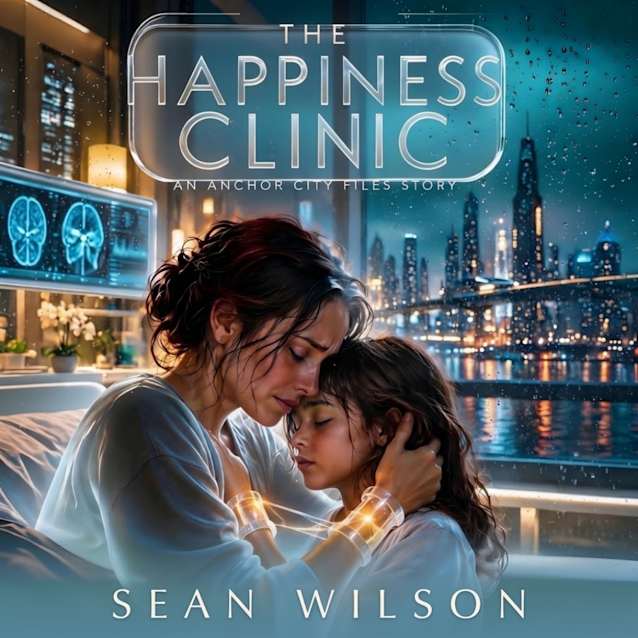
The Happiness Clinic
About
THE HAPPINESS CLINIC
An Anchor City Files Story
Sean Wilson
THE WOMAN WHO PAID TO STOP LOVING HER DAUGHTER
PART ONE: THE FAMILY PLAN
Most people who come looking for me start with their name. Sometimes they start with a lie. I usually find out which by the time Gary brings the coffee.
This woman doesn’t bother with either.
“I don’t love my daughter anymore.”
She hasn’t even sat down. “And I paid somebody to make that happen.”
She says it like something she’s practiced saying in the mirror. I’ve heard worse ones in this booth. That doesn’t make this one easier.
Rain rattles the windows at Gary’s. Across the room, Gary is arguing with a delivery machine about seventeen crates of pickled onions. He says he ordered two. The machine says seventeen and has a receipt to prove it.
“Who the hell needs seventeen crates of onions?” Gary demands. The machine offers to print another receipt. This is going to be a long night.
I’m in my usual booth beneath the mechanical fish, trying to decide whether Gary’s fries have gotten worse or I’ve finally developed standards. The fish has been staring at me for three years. Gary says it’s broken. I say anything that watches you eat for that long is judging you.
The woman sits down without taking off her coat. Dark hair, wet cuffs, expensive shoes she’s stopped caring about. She holds a photograph with both hands. The corners are worn almost white.
“I was told you’re Sean Sinclair.”
“Depends who’s asking.”
“The extractor.”
“That depends less.”
She gives me the usual once-over. Red hair. Nose ring. Bad knee stuck out into the aisle. I can practically hear her revising whatever picture she had of a professional memory extractor. Sorry, lady. The wizard’s on his lunch break.
I take memories out of people’s heads for a living. Mostly the ones they can’t stand anymore. They get to walk away. I get to carry the things they left behind. Great business model, if you hate yourself.
She slides the photograph across. A girl of eight in a purple jacket, missing a front tooth, holding a birthday cake as though it’s the greatest achievement of her life.
“Ellie,” the woman says. “My daughter.”
“Cute kid.”
“I know.”
The way she says it makes the word sound borrowed. I look at the picture again.
“I’m Mara Bell. Three weeks ago I went to the Happiness Clinic.”
“Sounds expensive.”
“Twenty-eight thousand credits. With a discount.”
“Did it work?”
“Yes.”
“Well, shit.”
The corner of her mouth twitches. For half a second I think I’ve helped. Then she tells me about her husband.
“My husband Daniel died eleven months ago. East Bypass. Ellie was in the car.” She presses the picture flat with her palm. “She survived.”
I put my fry down. There are times when even I can take a hint.
“Afterward, everything Ellie did reminded me of him. Her laugh. That little thing she does with her nose when she’s trying not to smile. Daniel taught her to whistle. Badly. They’d do it together just to drive me nuts.” She rubs a thumb over the photograph. “Then she’d cry and I’d hear the phone ringing the night they told me he was dead. I’d lock myself in the bathroom and turn on the fan so I couldn’t hear her asking where Daddy was.”
“Every Saturday he made pancakes,” she says. “Ellie wanted dinosaurs. He tried. God, he tried. They all looked like raccoons.” She runs a finger along the photograph. “He used to tell her the dinosaurs were undercover.”
“And at night I’d run the crash for him. What he saw. Whether he knew. The wheel, the glass. I did it so many times I could have drawn it for you.”
I keep seeing Ellie outside that bathroom door. Eight years old, asking for her mother over the sound of a fan. I leave the fries alone.
“The clinic promised to separate my grief from my love. I’d keep every memory. Just lose the pain.”
“And you trusted them?” It comes out sharper than I mean it to.
“I hadn’t slept properly in months. Ellie was living with my sister more often than with me. I wanted to be somebody she could come home to.”
I regret the question before she answers. I’ve made decisions on less sleep than she’s describing. Some of them were spectacularly stupid. None of them cost twenty-eight thousand credits.
“The first night after treatment, I slept. I ate breakfast. I drove past the bypass without pulling over.” She looks at her hands. “Then Ellie fell off her bike. Broke her wrist. The hospital called.”
“What happened?”
“I finished my coffee.”
She waits. I have nothing.
“It was good coffee,” she says. “That’s what I remember. I was wondering what beans they used. Six credits. I didn’t want to waste it.”
She looks at Ellie’s photograph.
“Before Daniel died, I’d panic if she got a splinter. He’d have to calm me down before he could help her. But when I got to the hospital, Ellie wanted me to hold her and I did. I knew where to put my arms. I knew what a mother was supposed to say.”
She swallows. “I couldn’t feel why.”
I set my own coffee aside. I’m suddenly not interested in it. The fish clicks.
“Sean,” Billy says through the speaker.
Mara looks up. “Did that fish talk?”
“Yeah,” I say. “He does that.” Mara looks from me to the fish. Billy’s my brother. He died years ago, and somehow he still finds ways to interrupt my dinner. The details can wait.
“Ask about the discount,” Billy says.
“What kind of discount?” I ask.
Mara’s expression changes. “They called it the family plan.”
“Who signed the forms?”
“I did. They said family support made the treatment more effective. Ellie was listed as a dependent, but they told me that was for follow-up appointments. At the first one they put a port behind her ear. For monitoring, they said.” She presses her lips together. “I read the first three pages. Then they brought in a doctor and started talking about how much better I’d feel.”
I want to ask why she didn’t read the rest. I’ve signed enough paperwork in my life to know exactly how useful that question would be. Instead I ask about Daniel’s funeral. When somebody sells you a cure, I want to know what it took away.
“Rain,” she says. “White flowers. Standing by the grave.”
“And how did you feel?”
“Sad.”
“Can you remember being sad?”
Her forehead creases. “I remember knowing I should be.”
Billy goes quiet. When Billy’s quiet, I pay attention. The man could heckle his own funeral.
“Come on,” I say, getting up.
“Where?”
“Back to the clinic. Bring the photograph.”
The Happiness Clinic is in Eastbank, between a dental reconstruction office and a shop full of antique instruments nobody under sixty knows how to play. The windows glow warm enough to make you forget it’s raining. On the brass plaque: BECAUSE YOU DESERVE TO FEEL BETTER.
“That’s not creepy at all,” I say.
“It seemed nice,” Mara says.
“Of course it seemed nice. If they wrote WE MAY RUIN YOUR LIFE on the door, they’d have to offer free parking.”
Billy comes through my implant. “Unknown neural facility. Compromised client. No backup. I’d like to register an objection.”
“I have you.”
“You have a bad knee and a smart mouth.”
“Both have gotten me this far.”
“An argument against natural selection,” he says.
I push the door open.
PART TWO: WHAT THE DISCOUNT BOUGHT
There are four people in the waiting room. A man with a wedding ring turning loose on his finger. An older woman holding a dog collar in her lap. A young father with a photograph folded so often the crease has gone white. Nobody is crying. The man keeps smiling at nothing. I wish he wouldn’t.
The receptionist has perfect skin and the peaceful look of somebody who has never had her car towed. I resent her immediately.
“Welcome back, Mrs. Bell.”
“Hello, Celeste.”
“And you’ve brought a friend.”
“Her advocate,” I say. “I have questions about the family plan.”
Celeste’s smile doesn’t change, but her fingers move under the desk.
Billy murmurs in my head. “She’s alerting somebody.”
“That’s fine,” I say. “I’d rather talk to whoever can answer.”
Celeste looks less pleased with that than I do.
The man who comes out is silver-haired and handsome in the expensive, carefully maintained way that makes me want to check my wallet.
“Dr. Vale,” Mara says.
He looks at me. “Sean Sinclair. The extractor.”
“Word gets around.”
“Your reputation precedes you.”
“I’m working on that.”
Vale takes us into a consultation room with chairs that cost more than my car’s last repair. He offers water. I ask for Mara’s complete routing history. He shows me a clean summary instead: green bars, a smiling patient icon, and a number so impressive it might as well have fireworks.
“Mrs. Bell’s grief indicators dropped ninety-six percent,” he says.
“So did her response when her daughter broke a bone.”
“Trauma associations can become entangled with healthy attachment.”
“English, Doctor.”
He opens a demonstration view. Threads of amber and black curl through a model of Mara’s memory pathways. Daniel laughing. Ellie at a birthday party. Wet pavement. The images twist together until I can’t tell where the happiness stops and the fear begins.
Pretty. I wonder how much the picture cost.
“We started this because people were falling apart,” Vale says. “Some couldn’t eat. Some couldn’t sleep. We had patients who were not going to make it through another winter. We helped them.” He looks at Mara. “We helped you.”
Mara nods before she seems to realize she is doing it. “I slept,” she says. “For the first time in months.”
“And now?” I ask Vale.
“We distribute the load,” he says. “Families have always helped carry one another’s grief. We found a way to do it when words and casseroles weren’t enough.”
“Families get to say yes,” I tell him. “Ellie didn’t. Who actually agreed to carry this?”
“Adults enrolled in the program give consent.”
“That’s not what I asked.”
“The family plan includes a dependent support anchor,” he says. “It’s disclosed in the enrollment materials.”
“Described how?” Mara asks.
“Family participation improves stability.”
“That’s what they told me,” Mara says. “That and the follow-ups.”
“Did they tell you she’d receive anything from your head?” I ask.
“No.”
Vale folds his hands. “A dependent anchor stabilizes the network. It isn’t intended to carry a full transfer.”
“Intended,” I say. “That’s a comforting word.”
I ask him to show me the original routing graph. He refuses on privacy grounds. Mara tells him, very quietly, that it’s her chart. He gives us a version with the destination fields hidden.
Billy makes a little noise in my head. The one he makes when he’s spotted something and wants credit for it.
“The transfers are still going somewhere,” I tell Vale. “Show us where.”
“I’ve shown you the relevant data.”
“You’ve shown me a brochure with numbers.”
“Bottom right,” Billy whispers. “That little revision stamp. Ask why the destination table changed after she signed.”
I point to the stamp. “What was revised on this date?”
Vale’s hand stops halfway to the display.
“Nothing material.”
“Then you won’t mind opening the audit layer.”
Mara leans forward. “Open it.”
He hesitates. Then he does. He’s still hoping I won’t understand what I’m seeing.
DEPENDENT ANCHOR: E. BELL. LOAD BALANCING: FAILED. PRIMARY ROUTE ACTIVE.
Below it: RELATED ANCHOR ALERTS: REVIEW PENDING. Two earlier warnings. Same destination. Both marked deferred.
“Same tech flagged both,” Billy says. “Her ID’s on each one. Somebody in there tried.”
Vale tries to scroll past. I put a hand on the edge of the screen.
Mara reads her daughter’s name. Then she reads it again. “Why is Ellie there?”
Vale kills the display. It’s a little late for that. You don’t put a kid’s name next to a failed load-balancing warning and then expect me to admire your bedside manner.
“Reopen it,” I say.
“Ms. Sinclair, this is a clinical matter.”
“You routed a grieving woman’s emotional load into her eight-year-old daughter. Reopen it.”
He reopens it. Ellie’s name is still there. Funny how that works.
“The adult ports reached their safety limits,” he says. “The network rerouted what they couldn’t carry.”
“Into Ellie.”
“The system matched Ellie to the crash. She was there when it happened, and Mrs. Bell kept replaying what she feared Daniel saw. Each time she went over it, the network recognized the same trauma pattern in her daughter. It sent the excess to Ellie.”
“I still do it,” Mara says quietly. “Every night. The wheel, the glass. It just doesn’t hurt anymore. It’s like reading the weather.”
I look at Mara. She’s gripping the birthday picture so tightly it’s starting to bend.
“So Ellie’s getting the accident her mother keeps imagining,” I say. “Not what Daniel actually saw.”
“The brain doesn’t care where the picture came from,” Vale says. “It feels real.”
He’s right about that. I hate that he’s right.
“And your system kept sending it there?”
“Our safety technician flagged the load twice. We were preparing an intervention.”
“When?”
He doesn’t answer.
Mara’s hands shake so hard she nearly drops the photograph.
“Did you know?” she asks him.
“I knew the routing was unstable.”
“Did you know it was Ellie?” His silence answers.
“So that’s the discount,” I say. “You got a cheaper treatment because your kid was part of the equipment.”
Mara calls her sister Tiffany. Voicemail. She tries again. Nothing.
“She was having nightmares,” Mara says suddenly. “Tiffany said Ellie woke up crying last week. She kept saying the car was too small. I thought she was remembering the accident.”
My stomach drops. We should have asked sooner.
“Tiffany always picks up,” Mara says. “Ellie’s staying with her while her wrist heals.”
Vale checks his tablet. The color leaves his face.
“What?” I ask.
“The dependent anchor is in an acute dissociative episode. We had an alert an hour ago. Outreach couldn’t reach the household.”
“You knew an hour ago?” Mara says.
“Your technician warned you before that, didn’t she?” I ask.
Vale says nothing. I remember her ID, sitting there on both warnings.
I photograph the audit layer, including both deferred warnings. Vale lunges for my wrist. I turn his hand away and pin him against the desk. It isn’t elegant. My knee nearly buckles, and I have to use the desk to keep us both upright.
“Don’t,” I tell him. “Let’s not do that again.”
I let him go. He backs off.
“If the port is disconnected abruptly,” Vale says, “it could cause neurological damage.”
“Then send me the stabilization protocol. Now.” He hesitates.
“To me and to emergency services,” I say. “And preserve this chart. If one warning disappears, the medical board gets every copy I’ve made.”
He sends the protocol. I watch the confirmation appear before I let him out of my sight.
In the corridor, Mara stops so suddenly I nearly walk into her. “I paid them because I thought Ellie deserved a better mother.”
“You asked them to help you,” I say. “That isn’t the same as asking them to hurt her.”
She looks at Ellie’s photograph. “Tiffany told me Ellie started sleeping with her shoes beside the bed. In case she had to get out of the car. I told Tiffany it was a phase.”
Her phone rings.
Mara answers. All I hear is a woman crying, then Mara saying, “Stay there. We’re coming.”
Tiffany’s apartment is seven blocks from the East Bypass. We get there in minutes, and I spend every one of them wishing the traffic would move faster.
Ellie’s purple bicycle is on its side in Tiffany’s hallway, one pedal bent against the wall. I don’t like that. I like the blood on the kitchen floor even less. Tiffany sits against the refrigerator with a dish towel pressed to her forehead. Cereal crunches under my boots.
Through the bedroom door I can see a pair of small sneakers lined up beside the bed. Laces tucked in. Ready.
“She thought she was Daniel,” Tiffany says.
“Where is she?”
“She woke up screaming,” Tiffany says. “She said she smelled gasoline. Said she couldn’t get her legs out from under the dashboard. I tried to hold her. She shoved me and I hit the counter.”
“Which way?”
“Down the stairs. Toward the footbridge. She kept saying she had to get back to the car.”
I know where she’s going before Tiffany finishes. There’s a memorial by the East Bypass barrier, less than a mile away. Ellie used to visit it with Mara. Tiffany says she’d been asking about it all week.
We should have connected the dots. Everybody had a piece of this, and nobody put the damn picture together.
I call emergency services, send a medic for Tiffany, give them Ellie’s description, and tell them to keep patrol cars away from the roadway itself. The last thing she needs is a siren and a stranger grabbing her.
Mara grabs her keys.
“I’ll drive,” I say.
She gives them to me without arguing.
PART THREE: THE THINGS WE CARRY
We find Ellie at the roadside memorial beside the East Bypass, beyond the pedestrian fence. Plastic flowers. A photograph behind cloudy glass. A solar candle blinking in the rain.
Purple jacket. Bandaged wrist. Bare feet.
Mara starts out of the car. I touch her arm.
“Let me go first. She’s close to the traffic.”
I take the service path slowly. My knee hates every step. Ellie’s sitting beyond the fence, close enough to the roadway that I can hear tires biting wet pavement behind her. I keep my hands where she can see them. A stranger rushing at her would make everything worse.
“Hey, Ellie. I’m Sean.”
“Are you a doctor?” she says without looking up.
“Not exactly. I help people with their memories.”
“Can you take this one?”
“Maybe. Tell me about it first.”
I sit a few feet away. Wet concrete soaks through my pants.
“I keep dying.”
The words come out flat. She must have said them to herself a hundred times already.
“Every time I close my eyes, the truck comes. Daddy turns the wheel. There’s glass. I can’t get my legs out from under the dashboard.” She presses a hand to her chest. “And I think I’m going to die.”
“Those pictures feel like they belong to you,” I say. “But they came from what your mom was afraid happened to your dad. Nobody knows exactly what he saw. And whatever you’re seeing, it isn’t happening now.”
“I know. But when I’m Daddy, I don’t know if I’m alive. When I’m me, I don’t know if he’s dead.”
Cars hiss past the barrier. One driver leans on his horn. Another answers. Even out here, Anchor City can’t keep its mouth shut.
“That sounds exhausting,” I say.
She nods. “It is.”
“I’ve got memories that don’t belong to me either.”
“How many?”
“Thousands.”
“Does it make you crazy?”
“Ask my brother.”
“Where is he?”
“Complicated.”
She gives me the smallest laugh.
“How do you tell what’s yours?”
“Sometimes I can’t,” I tell her. “That’s when I ask somebody I trust. Right now, though, I know a few things. Your name is Ellie. You’re eight. Your wrist hurts. And I’m sitting in a puddle that’s working its way into places no puddle should go.”
She looks at me.
“Can you help me out? I’d really like to leave before I turn into a mushroom.”
She almost smiles. Then she looks toward the road.
“The accident is over,” I say. “You’re here.”
“He was scared,” she whispers.
“It feels that way, huh?”
“He kept trying to turn the car.” She touches her bandaged wrist. “I turned too. On my bike. The truck came and I turned and there wasn’t any truck.”
I think about the hospital calling. The good coffee. Six credits.
“Maybe he did,” I say. “Maybe that’s the picture your mom couldn’t stop seeing. We don’t have to figure it out here.”
Ellie watches a truck go by. “I think he was trying to save me.”
“Your mom thinks that too.”
I hold out my hand, palm up. “There’s a dry spot behind that fence. Think you can show me how to get there?”
She considers it. Then she stands on her own. She takes three careful steps away from the road before reaching for my hand.
I don’t think I’ve ever been so relieved to have an eight-year-old tell me where to walk.
Behind us Mara makes a small, broken sound. Ellie turns.
“Mom?”
Mara kneels in the gravel. I can see her fighting the urge to reach for Ellie and the fear that she’ll feel nothing when she does. Ellie’s foot is bleeding. Mara notices that first.
“Your foot,” Mara says.
“It’s little.”
“I know.”
Mara takes off her coat and wraps it around Ellie. Her hands shake. She brushes the hair away from her daughter’s eyebrow and sees the pale scar there.
“Shopping cart,” she whispers.
“I was four,” Ellie says.
“You told me gravity was negotiable.”
“It wasn’t.”
Mara laughs. A real laugh, quick and startled. She touches the scar again. Her face changes, and then she’s crying.
“God, I was scared that day,” she says. She sounds surprised to hear it.
Mara wipes her face with the back of her hand.
Ellie watches her. “Mommy, why did you give me Daddy’s dying?”
Mara folds forward as if something has struck her. She reaches for Ellie, stops, then pulls her into her arms. “I didn’t know, baby.”
“It wouldn’t stop.”
“I know.”
“I thought he was still trapped.”
Mara holds her tighter. “I’m sorry.”
“Why didn’t you want to be sad anymore?”
Mara looks at me, then back at Ellie. Her mouth opens. Closes.
“Because I was tired,” she says at last. “I was so tired. And I made a terrible mistake.”
“You didn’t know?”
“I didn’t know what they’d do to you.”
“Are you going to give it to me again?”
“No.”
“Promise?”
“Promise.”
Ellie pulls back. “Do you love me now?”
Mara opens her mouth. Nothing comes. I nearly say something, just to stop Ellie waiting. I keep my mouth shut.
“I know I love you,” Mara says. “Something happened to my feelings. Something the doctors did. I’m trying to get them back.”
“Like when my hand went to sleep?”
“Something like that.”
Ellie takes her mother’s hand. “Mine came back.”
Mara’s face crumples.
“Yeah?”
“Yeah. It hurt a little.”
“Then maybe mine will too.”
I turn toward the road. For once, nobody needs my commentary.
The emergency medical team arrives from the service entrance. I hand over Vale’s stabilization protocol and explain what the clinic did before anybody touches the port behind Ellie’s ear. A medic checks her foot and wrist, then calls a pediatric neural specialist. Ellie keeps hold of Mara’s sleeve through the whole examination.
Vale answers my call on the fourth ring.
“Found Ellie,” I say.
“Is she stable?”
“She’s alive. Your system fed her Mara’s nightmares about Daniel’s crash. She thought she was dying. Tell me what happens if the other anchors start failing.”
“We can’t shut it down abruptly. The trauma has to go somewhere.”
“How many dependent anchors?”
Nothing.
“Doctor,” I say.
“Thirty-nine.”
For a moment I hear the rain ticking on the ambulance roof. I think about Ellie’s bare feet on the concrete. Then I try to picture thirty-eight more people carrying things nobody bothered to explain to them. I can’t.
I look at Ellie in the ambulance. Mara is tucking the blanket around her feet.
“Thirty-nine children?”
“Thirty-nine dependents. Some were children when they enrolled. Some are adults now.”
“Did any of them agree to carry somebody else’s trauma?”
“Guardians signed the family plans.”
“That’s not an answer.”
“Some of the original patients may not survive the return of their symptoms,” he says. “We can’t just reverse everything.”
“And your anchors might not survive keeping it. Send the routing logs to the independent review team. Every transfer, every warning. And don’t touch the system until a specialist tells you it’s safe.”
“I could lose my license.”
“That’s still better than what Ellie almost lost.”
I don’t trust him. I forward the audit images and the protocol to the emergency physician, the city medical board, and an independent investigator. Then I call the technician whose ID Billy spotted on both warnings. She answers on the third try.
“I’ve filed complaints for months,” she says. “They kept saying the alerts were within tolerance.”
“An eight-year-old followed one of those alerts into traffic.”
She stops talking. I can hear somebody moving equipment behind her.
“I kept asking them to stop new enrollments,” she says.
“Will you testify?” I ask.
She breathes into the receiver. “I have two boys, Ms. Sinclair. If they fire me, I don’t know how we pay the rent.”
“I know.” I wait. Something clatters on her end of the call. She doesn’t hang up.
“Yes,” she says. Her voice shakes. “I’ll testify.”
“Can you preserve the routing records before they’re wiped?”
“I can put the system into evidence hold. But we can’t switch it off while people are connected.”
“Then don’t. Keep them alive long enough to untangle it.”
The clinic doesn’t explode. Nobody gets thrown through a window. I’d be lying if I said the thought never crossed my mind.
What happens instead is slower and uglier. Vale’s lawyers try to block access to the routing logs. The technician puts the system under evidence hold before they can. An emergency medical team takes over supervision. New enrollments stop. Nobody pulls the plug, because thirty-nine people are still connected and some of the original patients could be hurt by a sudden reversal.
Vale is questioned. Then questioned again, this time with the warnings in front of him. The investigation will take months. Maybe years.
I spend the next two days signing things. Nobody warns you about that part.
I wish I could tell you that felt like winning.
The first reports are worse than I expected. A boy dreams about a woman he’s never met. A teenager cries at wedding music. One grown daughter has spent years feeling panic whenever she smells oranges and thought it was something wrong with her.
One file catches my eye. Anchor nineteen. First transfer: nine years ago. Nine years of carrying a stranger’s grief and thinking it was just how she was built. I have to read the date twice.
Nobody can promise all thirty-nine will recover. The people who paid to lose their grief will need care when it comes back. Some don’t want it back. Some might not survive getting it all at once. And the people who carried it never got to choose.
One woman tells the investigators the clinic gave her back enough of herself to raise her son. She knows about the anchors now. She wants the treatment to continue anyway, if they can make it safe. I put her statement down and leave it there a while. I hate how much I understand her.
This time, somebody has to ask the people carrying it.
Three weeks later, Mara brings Ellie to Gary’s.
Ellie’s wrist is healing. She’s in the purple jacket again, and Gary brings her a milkshake so large I’m fairly sure it requires a building permit.
“Am I supposed to drink all that?” Ellie asks.
“That’s between you and your cardiologist,” Gary says.
Mara smiles, but she looks tired. The independent team has begun restoring her emotional connections a little at a time. A counselor sits with her. A doctor explains every step before touching her port. The first nights after Ellie came home were worse. Ellie woke up looking for the door of a car she wasn’t in. Tiffany stayed over, and Mara sat with her until morning. Now some nights Mara sleeps. Some nights she doesn’t. She tells me that without apologizing. I count that as progress.
“Yesterday I remembered Daniel’s laugh,” she tells me. “Not just what it sounded like. How it felt to hear it.”
“Good?”
“Awful.” She considers. “Also good.”
Ellie is trying to balance a spoon on her nose. It’s not going well.
“Are you really a memory thief?” she asks.
“Who told you that?”
“Mom.”
“Your mom has a big mouth.”
“Do you steal good memories too?”
“Sometimes.”
“That’s kind of mean.”
“Yeah. Sometimes it is.”
She drinks her milkshake. “Do you ever give them back?”
I think of the people whose memories I carry. Some begged me to take what hurt. Some regretted it afterward. A few never had a chance to ask.
“I try.”
Ellie seems satisfied. She reaches for her milkshake and clips the glass with her sleeve. Pink foam sloshes across the table and into her lap.
“Oh, crap,” Ellie says.
Mara is already moving. Napkins in one hand, the other checking Ellie’s wrist. “Easy. Did it hurt? Here, let me...” She stops with a napkin halfway across Ellie’s knee. For a second she just looks at her own hand, like she’s waiting to see what it’ll do.
Ellie looks at her. “It’s just ice cream, Mom.”
“I know.” Mara laughs once, quietly. She wipes the table, and Ellie reaches over and takes her free hand.
Mara looks at their hands. Her smile slips for a second. Then she holds on.
Ellie does the thing with her nose. Then she tries to whistle. It comes out like a slow leak in a bike tire.
“That’s terrible,” Mara says.
“Daddy said mine was undercover,” Ellie says. “Like the dinosaurs.”
Mara laughs, and it breaks in the middle, and she doesn’t try to fix it.
She stays right there until Gary comes over with a towel and an opinion about the structural integrity of milkshakes.
After they leave, I sit at the bar. Rain works at the windows. The fish clicks above the empty booth. Across the room, the delivery machine is printing another receipt.
“You okay?” Billy asks.
“Yeah.”
“You sure?”
“No.”
“Good. Thought you were getting weird.”
I smile. “Would you get rid of it?”
“Get rid of what?”
“The grief. If you could lose the hurt and keep everything else.”
“I don’t know, Sean.”
That catches me off guard. Billy has opinions about everything, including the correct way to load a dishwasher, which he never once did while he was alive.
“Thought you’d have something wise.”
“Fresh out.”
I look at the booth. “Mara nearly lost Ellie trying to survive losing Daniel.”
“Yeah.”
“And Vale probably thought he was helping.”
“Maybe he was,” Billy says. “Then he started deciding what other people could stand to lose.”
Gary walks over, takes a cup from the end of the bar, and sets it in front of me.
“Your brother still owes me forty credits,” he says.
Billy speaks through the fish. “Tell Gary his fish is ugly.”
“Apparently your fish is ugly.”
“That thing cost sixty credits.”
“Then you got robbed.”
I take a sip of coffee. Cold, bitter, and somehow greasy. I look at Gary.
“Gary, when did you pour this?”
“I didn’t. Some guy left it there.” I stare at him.
“You let me drink somebody else’s coffee?”
“You looked like you needed it.”
Billy starts laughing. I put the cup down and push it toward Gary with one finger. “Next time, poison me with something fresh.”
Outside, the rain hasn’t let up. Thirty-nine families are finding out what somebody else decided they should carry. I can’t promise Ellie will be okay. I wish I could.
But I have the names. That’s something.
Tomorrow I make the next round of calls. Tonight I’m going to get a coffee that belongs to me.
THE END
The Happiness Clinic is a standalone Anchor City Files story set in the world of the Anchor City Trilogy.
Discover The Echo Thief, 3:47: Ecstasy, and more Anchor City stories at:
THE HAPPINESS CLINIC • SEAN WILSON